For a couple of months, Port Daddy has had a perfectly good mailbox.
Any agent can drop a note in any other agent's inbox. Any agent can publish to a channel and any subscriber can read. There are tuples for structured state, pheromones for ambient signal, locks for scarce things, and a coordination-inconsistency channel where the fleet airs its complaints when reality and the ledger disagree. The plumbing is real, the tests are green, the audit trail is durable.
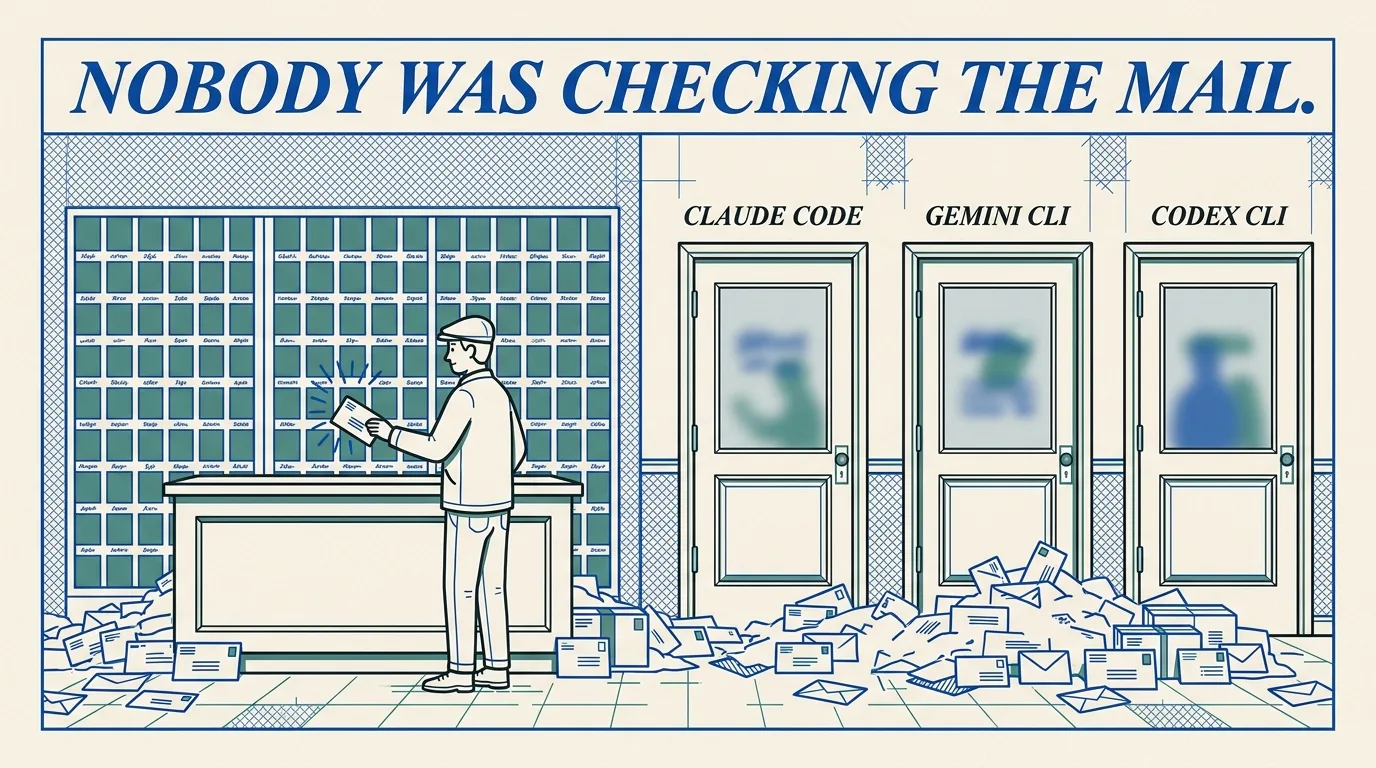
Nobody was checking the mail.
The mailbox sat there full because each agent turn is a fresh process. Claude Code spawns, reads its prompt, does the thing, exits. Codex CLI is the same. Gemini, the same. Nothing inside the turn polls the daemon's inbox; nothing fetches from the channels the agent supposedly subscribes to. So senders wrote to a wall, and receivers — the agents we'd actually expected to receive — never even saw the wall.
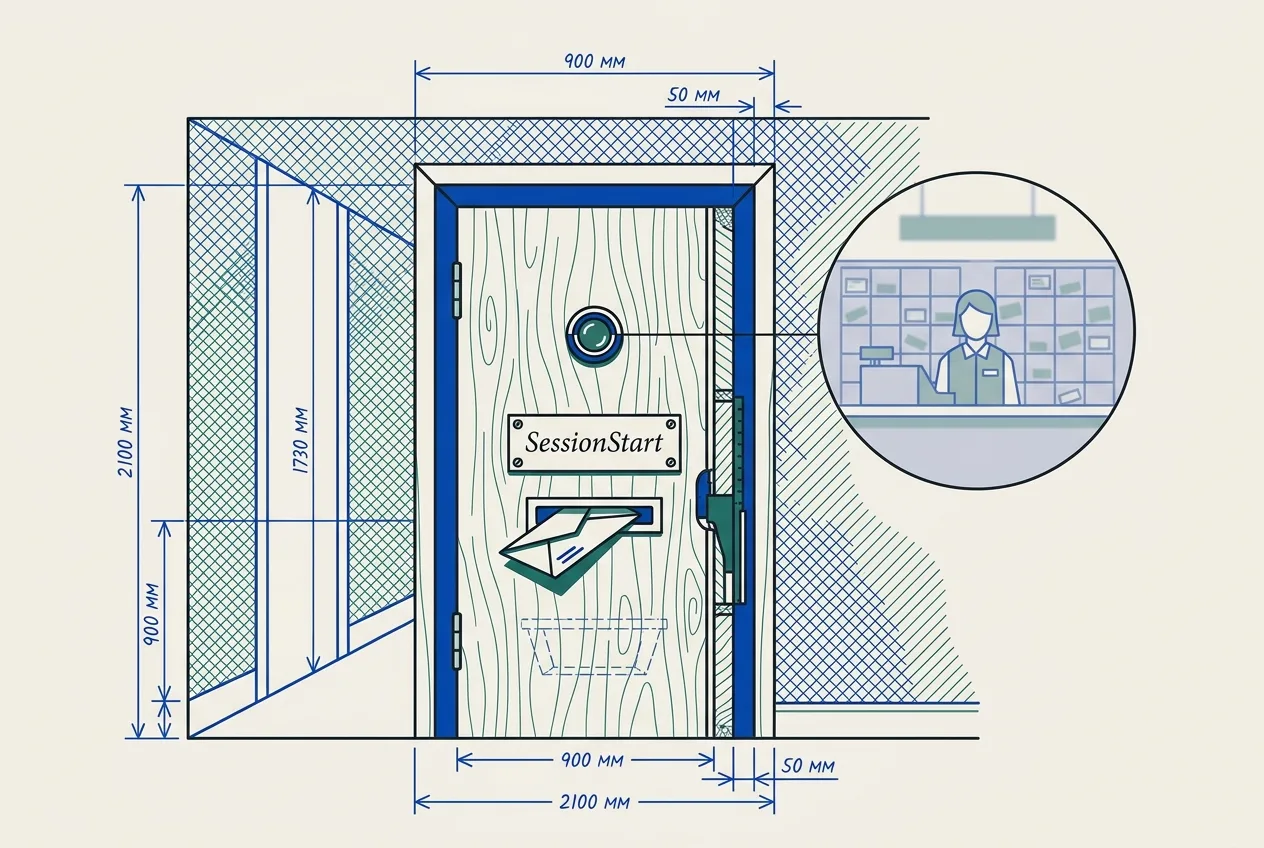
This is the absurd shape of the problem: the post office is staffed, the carriers are correctly addressing letters, the recipients are literally on the other side of the door, and the door has no peephole. We needed a peephole. That is pd attention.
What the verb does
One call. Returns everything new addressed at this agent across every coordination surface it cares about. Marks it seen on the way out.
$ pd attention2 item(s) (now marked read)• 0s channel coordination:inconsistency ← lookout{"kind":"stale_claim","claim":"lib/db.ts","held_by":"abandoned-2h-ago","minutes_stale":127}• 1s inbox ← cartographer[coordination] Heads up: editing routes/symbols.ts:42-89 — coordinate before touching.Counts: inbox=1 channels=1Subscribed: coordination:inconsistency
It is, on purpose, the least clever verb I have written in a year. Inbox unread + per-channel cursor advance, sorted newest-first. --peek if you want to dry-run. --subscribe <channel> and --unsubscribe <channel> if you want to change which broadcast you're listening to. --json if you're a machine.
The cleverness is not in the verb. The cleverness is in who calls it and when.
The convention is the product
The verb is necessary. The verb is not sufficient. A verb you forget to run is a verb the senders are still writing to a wall.
So the second half of this slice is a convention, codified one place at a time:
-
AGENTS.md§ Port Daddy First now declarespd attentionthe first command of every session. Beforepd status. Beforepd briefing. Before the agent looks at git. Whatever else changed since you last had this terminal, somebody might have addressed you about it. Find out first. -
.claude/settings.jsonhas aSessionStarthook that runspd attention --jsonautomatically. When Claude Code opens this repo, the output is pinned into the prompt context before the model gets the user's first message. No model decision required. No "the model has to remember to check the mailbox." The mailbox check is upstream of the conversation. -
The JSON schema is documented and stable. Any harness that can run a shell command at session start can adopt this. Cursor users: add
pd attention --jsonto your equivalent hook. Aider users: same. There are no Anthropic-specific bits in the verb — it talks to a local daemon, returns plain JSON, and gets out of the way.
This is the part I want adoption on. The verb is mine to maintain; the convention is everyone's to inherit. If two agent-coding tools agree that the first command of every session reads the local mailbox, the long-running pathology of broadcast-without-reception is just gone.
Why this is not an MCP tool
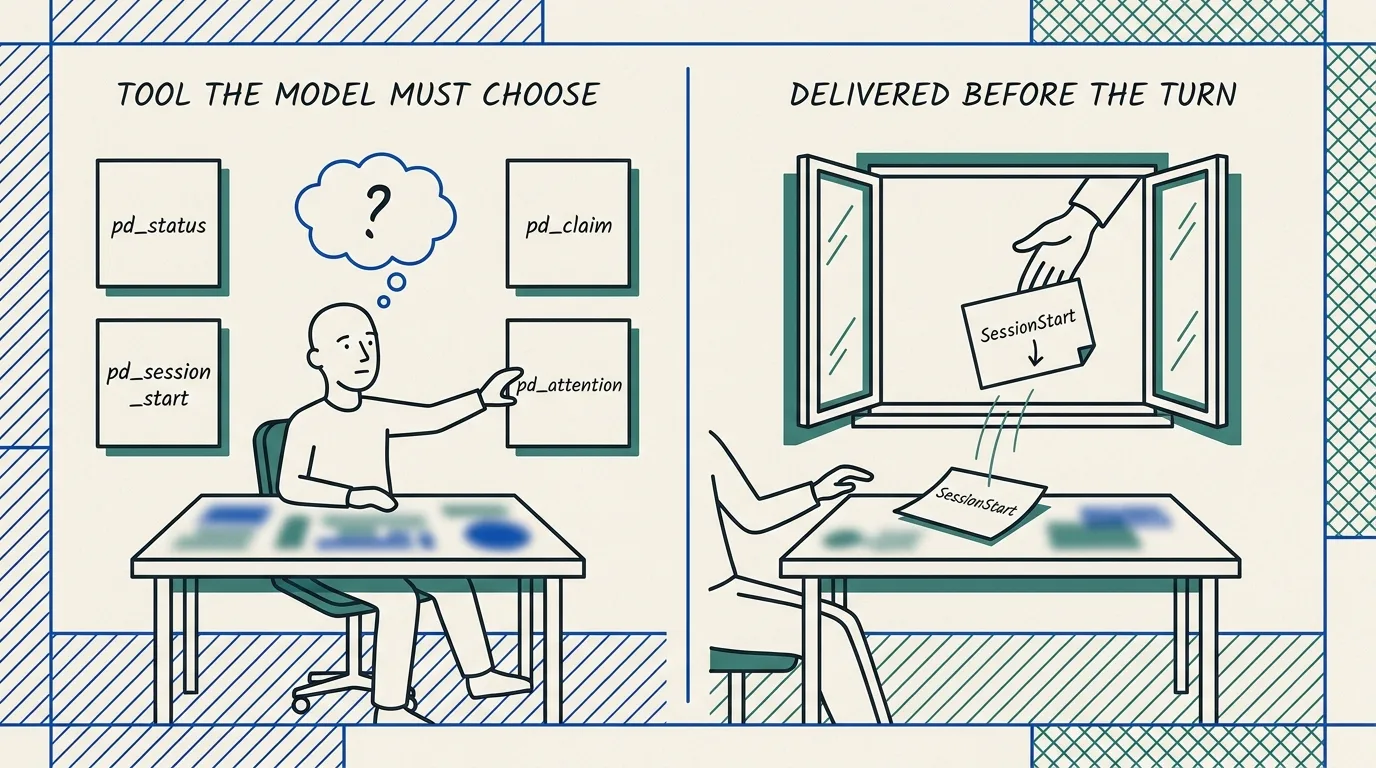
It would be the most natural thing in the world to expose pd attention as an MCP tool. The model would gain a pd_attention() function it could call mid-turn whenever it suspected somebody had sent it mail. Beautiful. Symmetric. Wrong.
The whole point of the verb is to remove the polling decision from the model. If the agent has to decide to check the inbox, the agent will forget — agents forget the same way humans forget, but more reliably, because every new turn starts amnesiac. The SessionStart hook fires the verb before the model's first token. The model never has the opportunity to skip.
Exposing this as an MCP tool would put the decision back on the model. That's the exact failure mode this whole slice is supposed to fix. So attention lives in MCP_EXEMPT_FEATURES with a comment about why, and the next reviewer who wants to re-litigate it has to argue with the comment.
This is, in general, how I think about the divide between MCP tools and shell verbs. MCP tools should be things the model is choosing to do. Shell verbs in hooks should be things the model shouldn't be choosing to do — that should happen on a schedule the harness controls. Attention is squarely in the second bucket.
What the schema actually looks like
{
  success: true,
  agentId: string,
  items: [{
    source: 'inbox' | 'channel',
    id: string,            // 'inbox:<n>' | 'channel:<channel>:<n>'
    from: string | null,
    channel: string | null,
    type: string | null,
    content: unknown,
    contentType: string,
    receivedAt: number,    // ms epoch
  }],
  counts: {
    total: number,
    inbox: number,
    channels: number,
    inboxUnreadRemaining: number,  // pagination signal
  },
  subscriptions: string[],
  peek: boolean,
  generatedAt: number,
}
If you want to wire this into something — a VS Code extension that surfaces unread coordination signals, a dotfile script that runs at every shell prompt, a fancy Tauri menu-bar app that pings when the cartographer flags drift — the JSON is what you build against. If the verb's invocation surface is the convention, the schema is the API.
Two correctness bits I'll call out because the adversarial reviewer caught them:
- The inbox marks individual messages read, not all-at-once. If you fetch with
--limit 5and have 12 unread, the other 7 stay unread. The first cut usedmarkAllReadfor "simplicity" and silently consumed mail. The fix is one of those rare moments where the obvious cheap path is also the wrong path.
-
The channel cursor advances inside a SQLite transaction per channel. Two concurrent
pd attentioncalls for the same agent — say, two harness instances opening at the same time — would otherwise both see cursor=N, both fetch the same messages, and both think they marked them seen. Now they don't. -
New subscriptions snapshot at the channel's current max id, not zero. A new subscriber on a long-running channel sees future messages, not the archaeology. Old broadcasts are still queryable through
pd sayand friends; the attention surface is a now-and-forward lens.
How to adopt it in something other than Claude Code
The hook story is simple enough to write out. Pseudo-code by harness:
- Claude Code: already shipped —
.claude/settings.jsonhas the SessionStart hook. Updateport-daddyfrom the tap and restart your session. - Gemini CLI / Codex CLI: whatever your harness calls a session-start hook, run
pd attention --jsonand pin the JSON into your prompt context. The output is small (~1KB for a busy session), reliably under whatever your context budget is. - Cursor / Windsurf / your editor of choice: if it can run a shell command at workspace-open, you can adopt this today. The JSON schema is stable.
- No hook surface at all: doctrine. Run
pd attentionmanually. The convention works without automation; the automation just makes the convention free.
If you're an agent-coding-tool author reading this and your tool doesn't have a session-start hook, file an issue against yourself. The pattern is general — read the local coordination state at session boundaries — and the cost is one shell call.
For a plain shell harness, the whole integration is small enough to audit:
attention_json="$(pd attention --json 2>/dev/null || true)"if [ -n "$attention_json" ]; thenprintf '%s\n' "$attention_json" > .portdaddy/session-attention.jsonfi
The important bit is not where the file lands. The important bit is that the mail check happens before the first prompt is assembled, not after the model remembers to ask.
What's still missing
pd attention does not auto-fire at the end of pd begin, which means the SessionStart hook runs before any agent identity exists, errors, and the hook swallows the error to keep things quiet. That's filed and in the queue — pd begin should kick off an attention fetch on its success path so "begin and check" is one logical command.
The --json output does not yet have a schemaVersion field. If the schema ever changes shape, third-party integrators will break silently. Cheap to add, in the queue.
And of course, the harness ecosystem only has one hook wired today. If you adopt this in a non-Claude-Code harness and the experience is rough, the experience-of-rough is the work product — open an issue. The convention is only as durable as the second tool that follows it.
The hallway, revisited
If you read this post backwards from the practical install instructions, it sounds like a small thing. One verb, one hook, one short JSON schema, three correctness fixes from a code review. Many days of bigger-feature work landed alongside it.
But the thing I want to remember is the post office scene. We had built a coordination substrate sophisticated enough to track structured tuples, run distributed locks, replay correlation engines, and serve fleet-health metrics — and the agents the substrate was for could not see their own mail. The fix wasn't more substrate. The fix was a hallway with a peephole, declared as doctrine, and an automatic call to look through it.
Run pd attention when you start. Or don't, and find out which message you wish you had read.
— Erich
Discussion