
What the whitepaper proves, what it measures, and what it doesn't know yet.
The book argues that autonomy only scales when authority, evidence, and consequence stay coupled at every effect boundary. That's an argument, and an argument alone wouldn't be worth much from a project that also sells the software, so this is where the receipts live: seven papers carrying the theorems the chapters lean on, an index that pins every executed result to the chapter holding it, a proof estate that runs in CI, pre-registered studies for the questions the book can't settle from its own results, and a ledger of every objection a reviewer raised with what we did about it.
7
20
36
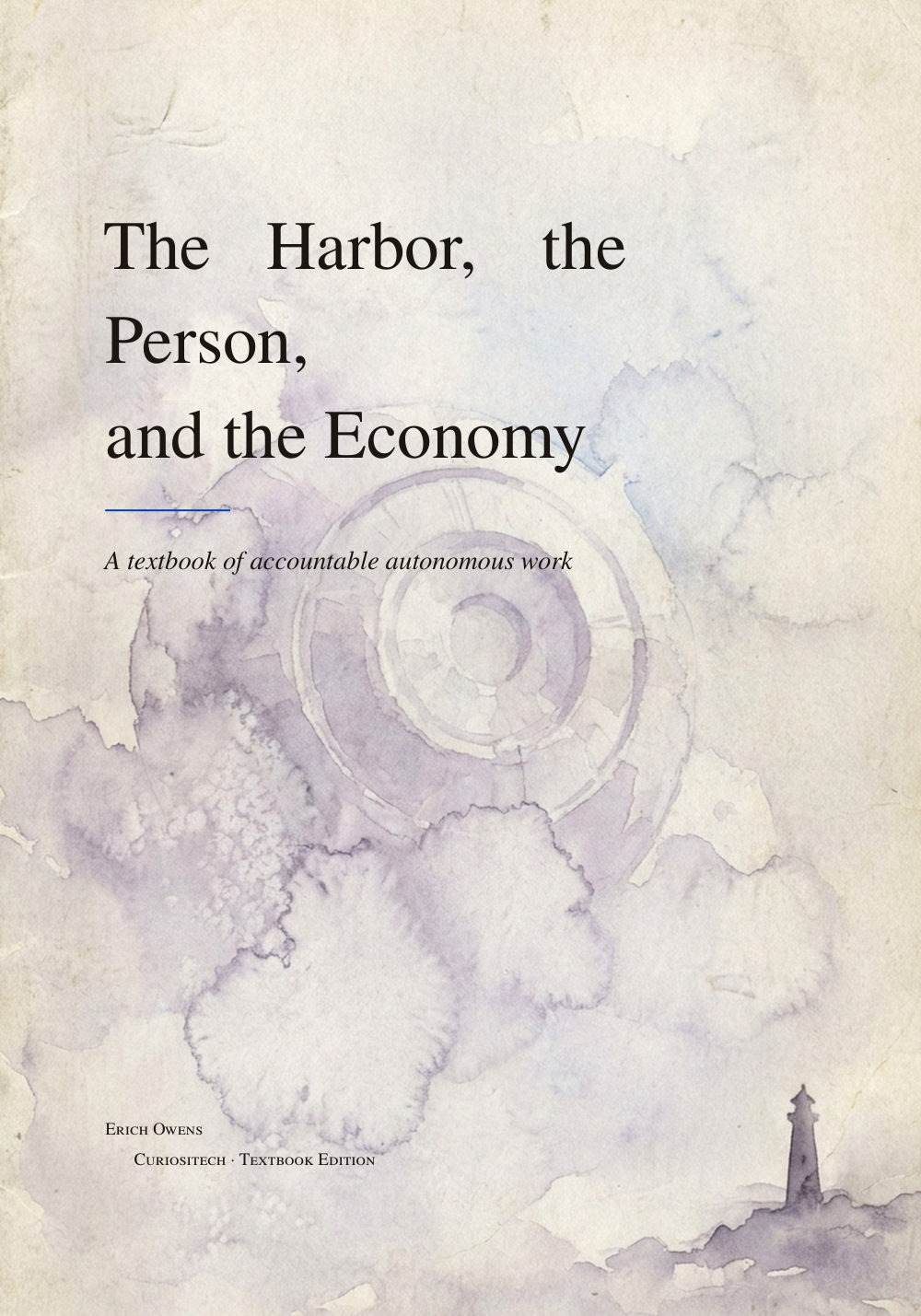 The Harbor, the Person, and the EconomyA textbook of accountable autonomous work. 8 chapters, 538 pages, free PDF.
Each paper below names the chapter that folds it in, and each chapter’s status table names the paper it stands on, so whichever side you start from, the other is one link away.
Read the whitepaperHow a result earns its way into a chapter
Four disciplines, and a result has to survive all of them before it's allowed near the prose. Every count below is read out of the repository's own records at build time (which is the reason a few of them are odd numbers).
The hypotheses get written before the code does.
One study is under way right now, with hypotheses, metrics, and a kill criterion committed before the first run — so we can’t quietly move the goalposts afterward. The report gets written whatever the outcome, and if a hypothesis fails, the chapter that depended on it is amended in the same pull request.
Prior art gets read against the paper itself.
6 prior-art dives have run to completion so far (2 clear, 4 narrow), and every single one of them found something to fix in the paper it was auditing — which is the point of running them. The 4 experiments that gave a wrong answer along the way are still in the repository, next to the lesson each one taught.
Whatever a machine can check, a machine checks on every pull request.
36 formal artifacts across 6 tools, 36 of them wired into CI with negative controls beside them. Of the numbers the chapters work out by hand, 14 carry the verified tag because a script regenerates them and 17 carry internal because the chapter’s own derivation is the only check — we’d rather you knew which is which.
Every objection anyone raised has a row.
759 review items from the adversarial rounds and the long-form critiques, and each has a status cell that says what happened to it: 561 were done (with the commit that landed them) and 198 were declined, with the reason written down. Declining is allowed. Leaving the cell blank isn’t.
Seven papers, one result each, written for a program committee.
Each is a standalone pre-print in the shape a program committee expects, and each card names the results it discharges, quotes the headline theorem verbatim, and points at the chapter of the book that folds it in. None of them depends on reading the others first.

The Price of a Summary
Information-Theoretic Limits of Agent Oversight
Reading digests instead of transcripts has an exact bit-price, not a rule of thumb — and the floor survived a pre-registered attempt to break it.
log₂C(N,k) − log₂C(m,k) bits, minimum, to guarantee catching all k critical artifacts among N while opening only m — 0/16 falsification attempts survived it, including an oracle encoder.
Chapter 4, The Legible Swarm. It prices the digest-with-zoom loop the flagship chapter only argues for in prose.
None has run against this paper yet; the falsification sweep it reports is its own.
Regimented or Enforced
The Controllability Boundary for Agent Governance
Whether a governance rule can be prevented before it happens or only caught after is decided by one theorem, not by how hard the runtime tries.
A safety policy is regimentable — preventable pre-effect — iff it is controllable in the Ramadge–Wonham sense. The design rule it proves: gate the channel, never the token.
Chapter 1, The Single-Writer Kernel. It mechanizes the kernel chapter’s own "detector vs. regimenter" distinction as a theorem.
The rumoured same-year preprint turned out to be real but orthogonal; the prior work that actually mattered was Basin et al. (TISSEC 2013), which nobody had flagged. Two correctness bugs against Schneider's theorem were found and fixed along the way, and the Ramadge–Wonham identification (the paper's real contribution) survived. Findings.
Reputation is Amortized Verification
Inspection Games for Agent Economies
A bonded judge stays honest exactly when audit-rate times damages clears the bribe — and stacking judges on judges holds at any depth on a finite bond, not an infinite one.
Lifetime audit spend falls from Θ(T) flat to Θ(log T) to O(1) as a track record grows. Reputation is not a soft layer bolted onto verification — it is the mechanism that amortizes its cost.
Chapter 5, From Spawn to Person. It prices the neutral judges the bridge chapter’s multi-axis reputation depends on.
Kofman and Lawarrée leave the unbounded-collateral regress as an open question in their conclusion, almost word for word the question the tower theorem answers, which makes them a supporting citation rather than a competitor. The same pass caught an arithmetic slip in the paper's own C=1 counter-case and fixed it. Findings.
The Sealed Harbor
Mutually Confidential Computation with Explicit, Gated, Bounded Releases
Two parties who share neither data nor model can still get one attributable joint computation, with every leak explicit, gated, and priced in bits — not trusted away.
Four independently verified pillars — exhaustive noninterference, the controllability boundary, ε-conservation of the release ledger, a canary detector with a quotable operating curve — priced honestly as q·b bits across q jobs, before timing channels, which are out of model.
Chapter 3, The Sealed Harbor. It is folded directly into its own chapter as the four-pillar assurance argument for mutually confidential computation.
Each of the four pillars narrows to a known result (delimited release, a privacy filter) that the paper mostly concedes up front; one corollary had leaned on a composition bound that doesn't hold in its setting and was rewritten to the model where it does. Findings.
Continuity Without Metaphysics
Identity, Reputation, and the Body Problem for Software Agents
Forking, distilling, swapping engines, or resurrecting an agent from a checkpoint needs no theory of personal identity — just three conservation laws on a ledger, proved.
Unattested, swapping in a cheap engine always pays — Akerlof’s death spiral runs inside one identity. Attest the engine id and the incentive flips to the planner’s own efficiency rule, at zero audit stake.
Chapter 5, From Spawn to Person. It gives the role-vs-person distinction its conservation proof: reputation survives a fork without minting itself.
No prior work proves the theorems, but Theorem 2a is Akerlof's lemons result wearing the wrong name (it had been called the unraveling theorem) and was renamed, and a crossing value that the paper's own figure contradicted was corrected. Findings.
What Needs an Authority
Mechanical Detection, Chartered Resolution, and the Exact Price of Sole Ownership
Conflict detection needs no authority at all — until one small step up in expressiveness makes it NP-complete, and that is exactly, provably, where an authority earns its keep.
One step outside the tractable fragment (disjunctive obligations), conflict-freedom is NP-complete — validated against a brute-force oracle on 3,000 random policy sets, zero disagreements. An authority is needed exactly where the algorithm ends.
Chapter 6, The Harbor Economy. It corrects the market chapter’s sole-owner-vs-pooled-swarm threshold with the actual Erlang-C crossing point.
The tractable-then-NP-complete shape was already mapped by the compliance-checking literature, so the framing had to narrow; the specific fragment, and conflict-freedom rather than compliance as the decision problem, survive as novel. An iff with the wrong strictness had been stated three different ways across four sites, and was unified. Findings.
The Cohomology of Equivocation
Detecting Split-View Lies in Federated Witness-Log Gossip by Sheaf Consistency
An analyst can convict an equivocating gossip peer across a link that was never directly checked, whenever that link sits on a cycle — and the size of the lie has a certified lower bound.
r = |s|·√(1 − R_eff(e)), closed form — the harness’s measured 1.2247 is exactly 3√(1 − 5/6). r > 0 proves no global history explains the data; a coalition on a cycle cancels to 0, measured at 6×10⁻¹⁵.
Chapter 8, The Federated Harbor. It gives the federation chapter’s witness-log gossip a detector for lies on links nobody directly compared.
The citation the sweep had flagged as fabricated is real (just irrelevant), so it was excluded on relevance rather than fraud. The genuine omission was the combinatorial-topology canon: Herlihy–Shavit and three foundational citations were added to close it. Findings.
Every executed result, and where it lives
One row per result, straight from the library index: the chapter that holds it, the paper that carries it, and how many of its numbers a script regenerates. A result with no paper listed is proved inside its chapter; a result with no chapter twin is cited from its paper, and the placement column says which.
| R1 | Read-poverty and the information floor | 4 · The Legible Swarm | 1 verified · 2 internal | in a paper and in its chapter | |
| R2 | Split-digest theorem (comonotone characterization) | 4 · The Legible Swarm | 2 verified · 0 internal | in a paper and in its chapter | |
| R3 | The derived regret head | 4 · The Legible Swarm | 2 verified · 0 internal | in a paper and in its chapter | |
| R4 | Digest-zoom Pareto frontier and the zoom-advantage theorem | 4 · The Legible Swarm | 2 verified · 2 internal | in a paper and in its chapter | |
| R5 | Hypervisor enforceability = supervisory control | 1 · The Single-Writer Kernel | 0 verified · 0 internal | in a paper and in its chapter | |
| R6 | Sheaf verdict: cohomology of equivocation | 8 · The Federated Harbor | 0 verified · 1 internal | in a paper and in its chapter | |
| R7 | Inspection tower: reputation is amortized verification | 5 · From Spawn to Person | 0 verified · 1 internal | in a paper and in its chapter | |
| R8 | The work-unit machine | 1 · The Single-Writer Kernel | chapter | 0 verified · 1 internal | in a paper and in its chapter |
| R9 | Sealed-room noninterference | 3 · The Sealed Harbor | 1 verified · 0 internal | in a paper and in its chapter | |
| R10 | Epsilon-conservation of the release ledger | 3 · The Sealed Harbor | 1 verified · 0 internal | in a paper and in its chapter | |
| R11 | Canary detection power and SPRT latency | 3 · The Sealed Harbor | 0 verified · 1 internal | in a paper and in its chapter | |
| R12 | No-mint reputation inheritance | 5 · From Spawn to Person | 0 verified · 1 internal | in a paper and in its chapter | |
| R13 | Engine substitution and resurrection soundness | 5 · From Spawn to Person | 3 verified · 2 internal | in a paper and in its chapter | |
| R14 | Costly-escalation threshold equilibrium and the debit tuning band | 4 · The Legible Swarm | chapter | 0 verified · 0 internal | proved in the chapter; no standalone paper |
| R15 | Queueing specialization boundary and the succession price | 4 · The Legible Swarm; 6 · The Harbor Economy | 0 verified · 0 internal | in a paper and in its chapter | |
| R16 | Context paging with an untrusted pin oracle | 4 · The Legible Swarm | chapter | 0 verified · 1 internal | proved in the chapter; no standalone paper |
| R17 | Tractable deontic-conflict fragment and its NP-complete frontier | 6 · The Harbor Economy | 0 verified · 4 internal | in a paper; the chapter cites it | |
| CR | Consistency radius of the completion residual (CR-1/2/3) | 8 · The Federated Harbor | 0 verified · 1 internal | in a paper; the chapter cites it | |
| B6 | The probation cliff (front-loaded newcomer restriction) | 5 · From Spawn to Person | 1 verified · 0 internal | in a paper and in its chapter | |
| prop:claim-signaling-ic | Claim-signaling incentive compatibility (mechanized discount-factor thresholds) | 7 · The Bonded Commons | 1 verified · 0 internal | in a paper and in its chapter |
Verified means a named script at a fixed seed regenerates the number in CI; internal means the chapter’s own derivation is the only check we have. The index itself is library-index.json, and a checker fails the build if a theorem turns up in any of the three corpora without a row claiming it.
One manifest, every proof, and only two states it can be in
A mechanized artifact is either wired into CI or marked retired with the reason, and a retired model can't be cited as evidence anywhere in the book. We used to have a third state (a proof that existed on disk and that everyone assumed still ran), and it's the reason this manifest exists. The book's appendix of mechanized claims is generated from it.

ProVerif
26TLA+/TLC
4Kani
3EasyCrypt
1TLA+/TLC + Apalache
1Z3
1
36 formal artifacts plus 5 result suites and simulations; 36 run in CI and 5 are retired and say why. Among the formal artifacts, 6 are negative controls — models that are supposed to fail — so a checker that had quietly stopped finding anything would go red rather than green.
- bonded-merkle-binding-easycrypt
EasyCrypt. EasyCrypt is not installed anywhere in this estate's CI; 3 `admit.` tactics remain undischarged (see binding.ec around lines 346, 371, 397 -- hashLeafE's algebraic combination).
- pd-relay-zero-trust-skill-template-proverif
ProVerif. a skill scaffold with open TODO queries (capability containment, revocation effectiveness, non-equivocation are all unfinished); not a claim about a real Port Daddy protocol and has no committed evidence file
What the book couldn't settle, it's now measuring
A study starts as a question the book's own results can't answer, and it becomes a protocol before it becomes code: hypotheses, metrics, a kill criterion, and a rule for what the book does with each possible outcome (including the embarrassing one).

Is the single-writer rail the right collaboration model, and is the enforcement point below the agent the right substrate?
The kernel chapter argues that confinement needs an enforcement point below the agent, and that much is a theorem. What it doesn't know is whether the single-writer rail is also the right way for several agents to share one repository, compared with a worktree per agent and a merge queue, which is what most of the industry does. Until this study reports, the rail is a design invariant and nothing stronger.
Real commit histories from three public repositories, replayed through six coordination substrates (an uncoordinated shared tree; advisory claims with a bypass rate; the enforced rail; a worktree per agent with a merge queue; and the rail with region-level claims) at 2, 4, 8, and 16 agents, with cooperative and impatient temperaments and twenty seeds per cell. The five metrics were fixed before the first run, so none could be added after the data came in.
S1, the substrate cost and controllability table (bare process, seccomp and Landlock, gVisor, Firecracker), needs KVM or unprivileged user namespaces, which the build container doesn't have, so it runs on the author's machine.
- H1
Confinement
Torn-tree incidents under advisory claims grow with the bypass rate, the agent count, and file overlap, and are zero under every enforced substrate. This one is the self-check: if it fails for the rail, the harness is broken, and we fix the harness before believing anything else it says.
- H2
The real question
At low overlap the merge queue matches or beats the rail on throughput and time to land. At high overlap the rail beats the merge queue on wasted work by at least a factor of two and matches it on throughput within 20%. If the merge queue matches or beats the rail on every metric in every high-overlap cell, the book demotes the rail to a confinement mechanism.
- H3
Enforcement, or only confinement
The shim used exactly as designed and the enforced rail are indistinguishable on every coordination metric. If that holds, the case for the enforcement point rests on confinement alone, and the book has to say so plainly.
- H4
Granularity
Region claims recover at least half of the rail's throughput deficit against the merge queue at high overlap, where a deficit exists.
One report, whatever the outcome. If H2's kill condition holds, the report says so in its first sentence, and the kernel chapter and the front matter are amended in the same pull request rather than in some later one. Numbers reach the book with the verified tag only once the pinned corpora and seeds regenerate them.
Proofs we have in one form and owe in a stronger one
- R8
Lift the work-unit machine to TLA+ and Apalache
The 536-state work-unit machine is checked exhaustively today by a Python model whose guards are proven load-bearing by mutation, which is real evidence but not the same kind as the rest of the estate. The lift restates it in TLA+ and checks it with Apalache, so the kernel's invariants sit in the same checker as the relay's and the ledger's.
Chapter 1 · The Single-Writer Kernel
- R9
Lift sealed-room noninterference to Isabelle
Noninterference holds under every interleaving to depth seven in the finite model, and depth seven is where the model checker stops, not where the property does. The unbounded statement is an unwinding argument, and the lift is to state it in Isabelle against the Archive of Formal Proofs' noninterference library.
Chapter 3 · The Sealed Harbor
Discharge the three admitted steps in the Merkle binding proof
The bond ledger's Merkle binding is sketched in EasyCrypt with three admitted tactics, and EasyCrypt doesn't run in CI, so right now this is a proof outline that a person reviewed rather than a proof a machine checked. The manifest grades it partial until the admits are discharged and the tool is pinned.
Chapter 7 · The Bonded Commons
The minimum viable take-rate
The economy chapter prices the three-sided market on one conserving ledger, but it doesn't yet derive the smallest platform take that keeps that market open, and that number is the one a pricing page would eventually have to cite.
Chapter 6 · The Harbor Economy
What the book names as its own next work
Each of these is a specific silence that a product decision ran into, or a boundary a theorem draws around itself, with a link to the document that named it and the chapter that owes it. A problem leaves this list when a section, a proof, or a study closes it, and not before.

Authority transfer between harbors
Writer epochs appear in the book only as a revocation mechanism. There is no written procedure for freezing a harbor's authority, exporting it, importing it under verification, activating the new epoch, and rolling back by epoch, and the Chartroom cutover decision can't be graded until there is. Of the silences, this is the one we'd fix first.
The release ledger in the other direction
The release ledger meters the customer's data leaving the sealed room. A provider's implementation leaking out through the customer's queries is the same ledger with the roles swapped, and nobody has written it down yet, so no claim about protecting provider IP can be graded until someone does.
Dispute windows, partial work, and refunds
The Bonded Commons gives you conservation and two-of-three settlement, and the economy chapter gives you prices, but neither says anything about the time and arithmetic of a dispute: how long the window stays open, what a half-delivered work order is worth, and how a refund conserves.
A constitution for the registry
Who may suspend a publisher, under what review, and with what appeal. The book has the bond and the audit worked out; the emergency path, the one you need on the bad day, isn't written.
One label scheme for product, roadmap, and book
The product's five evidence labels, the book's five assurance modes, and its four statement kinds ought to be one table, so that a product badge, a roadmap item, and a chapter claim all speak the same words and nobody has to translate between them.
Equivocation by a coalition on a cycle
The consistency radius certifies a lower bound on any single equivocator's lie, but two liars placed on the same cycle can cancel each other to a residual of zero (measured at 6×10⁻¹⁵, which is to say exactly zero up to floating point). Catching coordinated equivocation needs a different invariant, and we don't have it.
Context paging against an adaptive pin adversary
The paging bound holds against a pin oracle corrupted at a fixed rate, with repair on touch. An adversary that adapts its corruptions to the operator's access pattern is strictly stronger than the greedy one the proof assumes, and nobody has tested against it.
An incremental conflict checker for the tractable fragment
Conflict-freedom inside the tractable fragment is decided in polynomial time, with a witness, from scratch every time. An amortized checker that updates the witness as a single policy changes is stated in the paper and hasn't been built.
The experiments that gave the wrong answer stay in the repository
Each one sits next to its corrected version with the lesson it taught, on the theory that the next person about to make the same mistake should find it already made, annotated, and a little embarrassing.

The meter was charging bits for tie-breaking as well as identification, which manufactured 8 spurious floor violations out of 14 and briefly looked like a refutation of the theorem. The corrected experiment is the one the paper cites.
Zoom was tested in the dense-flag regime, which is exactly where it can't help, and duly showed a 0.5× "advantage" that meant nothing. The frontier only exists where flags are sparse, and the experiment now says so.
Computed the dimension of the abstract sheaf's first cohomology, a number that doesn't depend on the data at all, when the quantity that detects a lie is the obstruction of the particular observed assignment.
A vector-stalk wrapper whose random restriction maps were surjective (so the cokernel was always zero), on top of inconsistent masking and the wrong partition detector. Thrown out and rebuilt from a minimal proof of the mechanism.
The argument is in the book; the proofs are here; the record is in the repository
This whole page is rendered from one file, docs/harbor-research/program.json, and that file is checked on every pull request against the results index, the proof manifest, the review ledger, and whatever studies are on disk — so when the program moves, this page is forced to move with it, and we can't forget to update it. Last synced 2026-09-07.